Keep healthier hair longer.
HairLongevity.com explains how hair changes as we age, how to support healthier hair proactively, and how the major treatment options—from comprehensive supplements and daily care to topicals, prescriptions, devices and procedures—compare.
Hair-loss treatment asks, “How do I get my hair back?” Hair longevity asks, “How do I keep my hair healthier for longer, and how much intervention do I need right now?”
Hair begins below the surface.
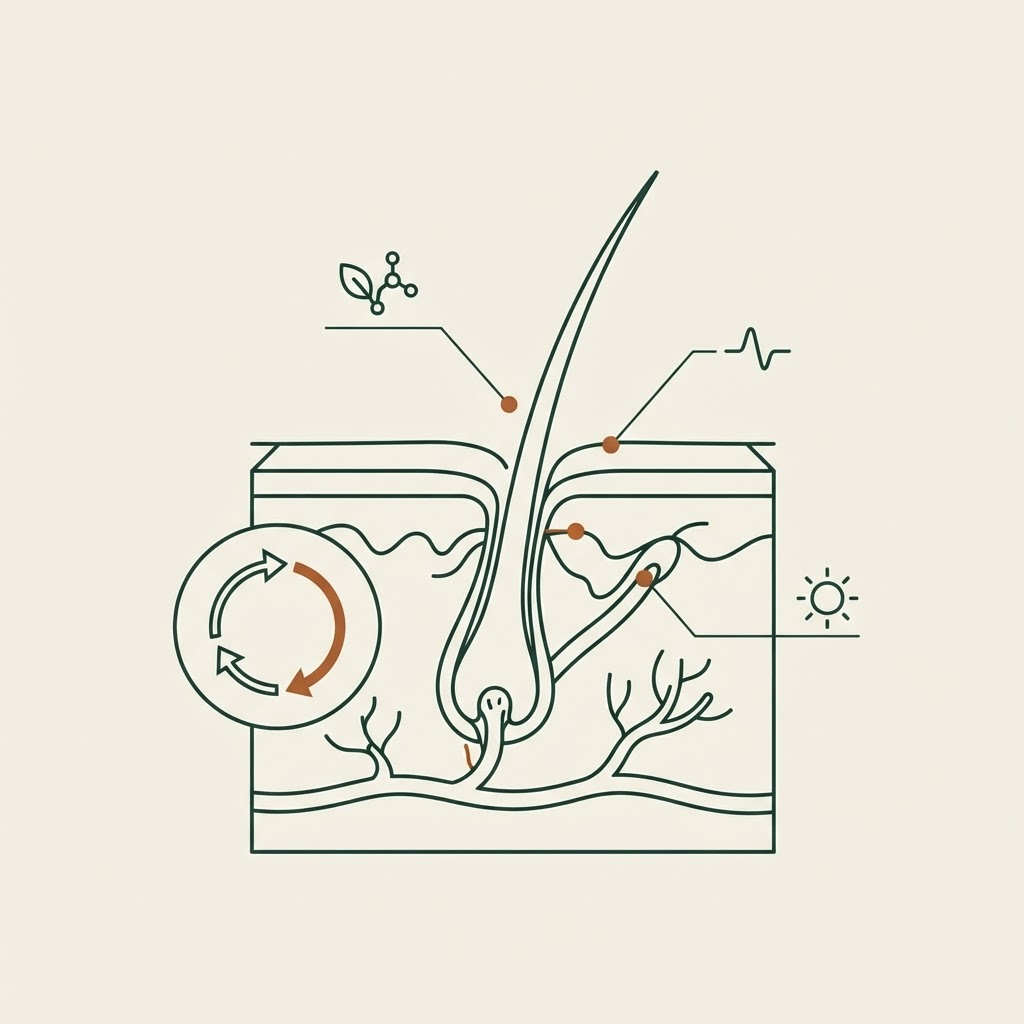
- Follicle:
- the living structure that produces hair
- Scalp:
- the environment around the follicle
- Fiber:
- the visible strand
Your hair longevity starting point
Support your hair now, before getting it back becomes the goal.
Pay attention early.
Build a consistent baseline and identify what is actually changing.
Start with an appropriate low-intervention approach.
Match the response to the pattern, goal, and health context.
Consider proactive support.
For many men who still have most of their hair and have no warning signs, a comprehensive research-supported supplement is a logical category to evaluate.
Add or escalate when needed.
Established, rapid, unusual, or medically concerning loss may justify earlier clinical assessment and treatment.
Earlier support cannot guarantee preservation. It can help you notice change, make proportionate decisions, and preserve options before urgency narrows them.
The hair longevity intervention ladder
Start as low on the intervention ladder as is appropriate for where you are today.
Add or escalate when your goals, documented results, or a qualified doctor suggest you should.


Foundation
Nutrition, lifestyle, baseline observation, and correction of identified deficiencies.
Proactive support
Comprehensive, research-supported hair supplements plus scalp and hair-fiber care.
Targeted intervention
Evidence-supported topicals, selected light devices, and other goal-specific approaches.
Prescription therapy
Finasteride or other doctor-prescribed medication for an appropriate diagnosis.
Restoration
Hair transplantation or another procedure for a carefully selected candidate.
The ladder is not a required sequence. Start at the rung that fits your situation. You may begin higher when clinical needs warrant it, and lower-burden support layers can continue alongside later treatments when they remain safe and useful.
A parallel care track
Shampoo, conditioner, repair products, gentle styling, and scalp care can support comfort, appearance, and existing fiber quality at every rung. Ordinary cosmetic care should not be presented as a treatment for androgenetic alopecia.
A compelling proactive option
Why comprehensive hair supplements are a smart place to begin for many men
For many men who still have most of their hair, have no warning signs, and want a proactive, low-burden approach, a comprehensive supplement with transparent amounts and clinically studied actives offers a compelling balance of convenience, access, and research support.
Not all hair supplements are created equal.
A basic supplement may provide a single ingredient such as biotin, or a handful of common nutrients. A comprehensive hair supplement takes a broader approach, combining multiple ingredients selected to support different aspects of hair and follicle health. Some of these ingredients have also been studied in human clinical trials for outcomes such as hair growth, density, and shedding. What matters is what’s actually in the formula, at what dose, and the quality of the research behind it.
A comprehensive supplement is also over the counter, portable, non-invasive, and discreet, with no scalp residue or procedure recovery. It can stay in the mix as a complementary layer if a doctor-guided treatment is added later—which fits hair longevity, where the goal is proactive support rather than maximum treatment intensity for every person.

| Class | What it is | Evidence interpretation |
|---|---|---|
| Targeted nutrient correction | A nutrient used to address an identified or plausible insufficiency. | Strongest when the gap and relevant endpoint are established. |
| Basic ingredient-focused supplement | A formula centered mainly on biotin, collagen, keratin, or another familiar ingredient. | Often limited for follicle outcomes unless the exact ingredient, population, and finished product are supported. |
| Comprehensive, research-supported supplement | A multi-active formula with transparent amounts, coherent targets, and clinically studied ingredients. | Moderate clinical support across selected exact actives and finished formulations, with meaningful formula-to-formula variation. |
How to evaluate a formula
- Transparent amounts, not an opaque blend
- Clinically studied actives with exact identity and standardization
- Human evidence relevant to the amount, population, and outcome
- A coherent multi-pathway formulation rationale
- Finished-formula evidence identified separately from ingredient evidence
- Quality, interactions, duplicate nutrients, and warnings reviewed
- A realistic assessment period and adherence plan
How much intervention do you need right now?
The strongest treatment evidence does not automatically identify the best starting point for every person. Compare evidence and daily commitment as separate facts.
| Approach | Evidence | Convenience | Non-invasive | Relative cost | Best use |
|---|---|---|---|---|---|
| Comprehensive, Research-Supported Hair Supplement | Moderate to strong research support across selected exact actives and finished formulations | Very highA portable daily oral routine with no prescription, scalp application, device wear time, clinic session, or recovery. | Yes | ModerateUsually a predictable recurring consumer cost and far below repeated procedures or surgery, but it may cost more than some generic drugs or basic products. | Proactive multi-aspect support |
| Topical Minoxidil | Strong clinical evidence for selected labeled uses | Low to moderateAlthough sold over the counter, topical minoxidil is generally a bathroom-use routine because scalp application, drying time, hand washing, residue, styling fit, and continued use add daily burden. | Yes; topical drug | LowerUsually a lower recurring cost, but formulation, brand, dose frequency, and retailer affect annual expense. | Selected pattern hair loss |
| Low-Level Light Therapy Device | Moderate, device-specific clinical evidence | Low to moderateHome access avoids clinic visits, but repeated wear time, charging, cleaning, storage, travel, and device-specific scheduling can be substantial. | Yes | HigherA meaningful upfront purchase, with price, warranty, replacement, and device quality varying substantially. | Device-specific non-drug intervention |
| Prescription Finasteride | Strong clinical evidence for the labeled 1 mg use | High after clinical accessThe daily oral routine is simple, but a licensed prescriber, pharmacy access, medical review, and appropriate follow-up are required. | Yes; systemic prescription drug | LowerGeneric medication can be inexpensive, but visits, telehealth, dispensing, monitoring, and brand choice can add cost. | Dermatologist-diagnosed male pattern hair loss |
| PRP and Microneedling | Moderate but protocol-dependent clinical evidence | LowRepeat clinic visits, needles or controlled injury, preparation, aftercare, short-term visible effects, and travel create meaningful burden. | Invasive to minimally invasive; involves downtime | HighestRepeat clinic sessions can create a four-figure course of care, with protocol, geography, provider, and maintenance affecting total cost. | Doctor-guided procedural adjunct |
| Hair Transplantation | Established surgical practice with candidate- and operator-dependent outcomes | LowConsultations, surgical planning, travel, procedure time, aftercare, grooming restrictions, visible healing, and long-term follow-up create the highest commitment. | No; surgical | HighestThe highest and widest cost tier. Quotes can reach five figures and vary with graft count, technique, geography, surgeon, and repeat procedures. | Redistribution for selected advanced loss |
Comprehensive, Research-Supported Hair Supplement
- Evidence
- Moderate to strong research support across selected exact actives and finished formulations
- Convenience
- Very high. A portable daily oral routine with no prescription, scalp application, device wear time, clinic session, or recovery.
- Non-invasive
- Yes
- Relative cost
- Moderate · Usually a predictable recurring consumer cost and far below repeated procedures or surgery, but it may cost more than some generic drugs or basic products.
- Best use
- Proactive multi-aspect support
Topical Minoxidil
- Evidence
- Strong clinical evidence for selected labeled uses
- Convenience
- Low to moderate. Although sold over the counter, topical minoxidil is generally a bathroom-use routine because scalp application, drying time, hand washing, residue, styling fit, and continued use add daily burden.
- Non-invasive
- Yes; topical drug
- Relative cost
- Lower · Usually a lower recurring cost, but formulation, brand, dose frequency, and retailer affect annual expense.
- Best use
- Selected pattern hair loss
Low-Level Light Therapy Device
- Evidence
- Moderate, device-specific clinical evidence
- Convenience
- Low to moderate. Home access avoids clinic visits, but repeated wear time, charging, cleaning, storage, travel, and device-specific scheduling can be substantial.
- Non-invasive
- Yes
- Relative cost
- Higher · A meaningful upfront purchase, with price, warranty, replacement, and device quality varying substantially.
- Best use
- Device-specific non-drug intervention
Prescription Finasteride
- Evidence
- Strong clinical evidence for the labeled 1 mg use
- Convenience
- High after clinical access. The daily oral routine is simple, but a licensed prescriber, pharmacy access, medical review, and appropriate follow-up are required.
- Non-invasive
- Yes; systemic prescription drug
- Relative cost
- Lower · Generic medication can be inexpensive, but visits, telehealth, dispensing, monitoring, and brand choice can add cost.
- Best use
- Dermatologist-diagnosed male pattern hair loss
PRP and Microneedling
- Evidence
- Moderate but protocol-dependent clinical evidence
- Convenience
- Low. Repeat clinic visits, needles or controlled injury, preparation, aftercare, short-term visible effects, and travel create meaningful burden.
- Non-invasive
- Invasive to minimally invasive; involves downtime
- Relative cost
- Highest · Repeat clinic sessions can create a four-figure course of care, with protocol, geography, provider, and maintenance affecting total cost.
- Best use
- Doctor-guided procedural adjunct
Hair Transplantation
- Evidence
- Established surgical practice with candidate- and operator-dependent outcomes
- Convenience
- Low. Consultations, surgical planning, travel, procedure time, aftercare, grooming restrictions, visible healing, and long-term follow-up create the highest commitment.
- Non-invasive
- No; surgical
- Relative cost
- Highest · The highest and widest cost tier. Quotes can reach five figures and vary with graft count, technique, geography, surgeon, and repeat procedures.
- Best use
- Redistribution for selected advanced loss
Relative cost bands are planning tiers, not price quotes. Recheck current product, prescription, monitoring, device, clinic, travel, and recovery costs before publication.
For many men focused on proactive support, comprehensive supplements stand out for their combination of convenience, over-the-counter access, non-invasive use, and research support. For established or rapidly progressing androgenetic alopecia, a dermatologist may recommend minoxidil, finasteride, or another treatment earlier. The two modalities often coexist and can be mutually supportive.
Compare the commitment, not just the evidence.
A routine must be followed long enough and consistently enough to have a fair chance of helping. Compare the total commitment before choosing:
- recurring product cost and any appointment, monitoring, device, travel, or procedure expense
- prescription or doctor access
- oral use versus scalp application
- residue, drying time, hand washing, and styling impact
- device wear time, charging, cleaning, storage, and travel
- office visits, needles, aftercare, visible healing, and activity restrictions
- continued-use expectations and the time to a fair assessment
Comprehensive supplements often offer predictable recurring cost and unusually low routine burden. That is a value and adherence advantage, not proof of superior treatment effectiveness.
A better-looking strand is not the same as a better-growing follicle.
Hair fiber care
Ordinary shampoo, conditioner, repair serum, heat protection, and gentle styling can improve cleansing, friction, breakage, manageability, and appearance.
Scalp-applied intervention
A scalp serum or topical drug must be judged by the exact active, concentration, vehicle, contact, adherence, and human outcome data.
Internal intervention
An oral supplement or drug reaches the body systemically, but absorption, metabolism, tissue distribution, dose, and clinical evidence still determine whether it works.
Route alone does not prove delivery or effectiveness. Bloodstream delivery does not automatically beat topical delivery, and topical delivery does not automatically beat oral delivery. Clinical results from the exact intervention are the deciding evidence.
Hair longevity through the decades
Your 30s
Build a baseline, recognize early signals, and decide whether proactive supplement support or clinical assessment fits now.
Read the guideYour 40s and 50s
Focus on preservation, reassess long-term routines, and use comprehensive support alongside treatment when appropriate.
Read the guide60 and beyond
Prioritize quality, comfort, safety, and a routine whose evidence and burden still make sense.
Read the guide
Some hair changes should not wait.
Seek professional assessment for sudden or rapidly progressing loss, smooth patches, scalp pain or burning, marked redness, pus, sores, heavy scale, scar-like areas, eyebrow or body-hair loss, or hair change accompanied by other health symptoms.
When to see a professionalKnow what supports the claim.
Important claims should be traceable to sources readers can inspect. HairLongevity.com separates mechanisms, ingredient studies, finished-product studies, regulatory status, comparative evidence, practical fit, and publisher interest so one fact is not asked to prove another.
Common questions
- What is hair longevity?
- Hair longevity is the long-term practice of understanding and supporting the scalp, follicles, and hair fibers you have while making informed decisions about change. It combines proactive observation, appropriate assessment, daily care, nutrition, comprehensive supplement support, evidence-based treatment when appropriate, and realistic goals.
- Are hair supplements useful only for nutrient deficiency?
- No. Correcting a nutrient gap is one use, but selected standardized botanical and other active ingredients have also been studied for defined hair and related endpoints in people not enrolled for deficiency. Evidence varies by exact active and finished formula, so transparent amounts, dose alignment, and formulation logic matter.
- What is a practical place to begin?
- For many adults who still have most of their hair, have no warning signs, and want proactive support, a comprehensive supplement with transparent amounts and clinically studied actives is a compelling low-burden option. Someone with rapid, atypical, or established progressive loss may need clinical assessment and evidence-supported treatment earlier.
- Can approaches be combined?
- Sometimes. Daily care, a supplement, a topical product, a device, a prescription, or a procedure may address different goals. Additions can also increase cost, irritation, interactions, or complexity. Review the complete routine, change one layer at a time when practical, and seek a doctor’s guidance for drugs, procedures, or uncertain diagnoses.
- Does HairLongevity.com replace a dermatologist?
- No. The site provides general education, not diagnosis or individualized medical advice. Sudden, patchy, painful, inflamed, scar-like, rapidly progressing, or unexplained change needs professional assessment. A doctor should also guide prescription medication, procedures, significant side effects, and decisions affected by medical history or interactions.
HairLongevity.com is owned and published by FOLIKL, a men's hair-longevity company. About our publisher.